Bedi & Sass (2022) conducted a meta-analytic review of the consequences of employee time management behaviors on several employee outcomes. What are the main insights?
-
It may not come as a big surprise, but it is encouraging that data support the association between time management and various beneficial employee outcomes, such as increased job satisfaction, job performance, and lower levels of stress and burnout. Unfortunately, the “proven” association is not causal, as the majority of studies were cross-sectional. In fact, there are not many studies on the causal effects of time management. The exception to this is procrastination, for which there is evidence that time management can help - see, for example, the meta-analysis by Van Eerde & Klingsieck (2018) on this topic.
-
The relationship between time management and employee outcomes is not only direct but also partially mediated by work-family conflict. This finding underscores the importance of work-life balance and highlights the need for organizations to help employees better address this specific issue, as it may positively affect a variety of employee outcomes.
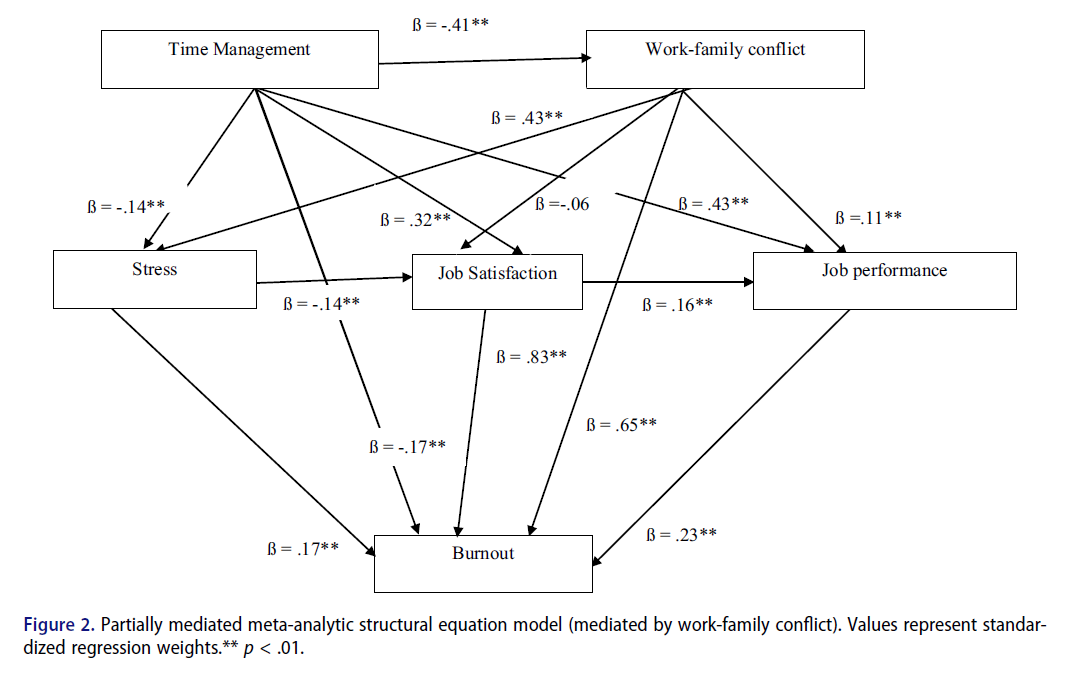
- Perceived control over time, achieved through the use of time management, shows incremental validity in predicting job satisfaction, job performance, and stress with respect to the personality trait of conscientiousness. This suggests that regardless of an individual’s innate level of prudence, they may benefit from adopting time management in their professional lives.
Related notes
- Timeboxing. Does it really work?
- Surprising finding on the impact of job demands and control on workers’ well-being
- Does agile pay off?
- Self-Leadership: A New Superpower?
- Effectiveness of micro-breaks at work
📄 Read the original post with full outputs on my blog.