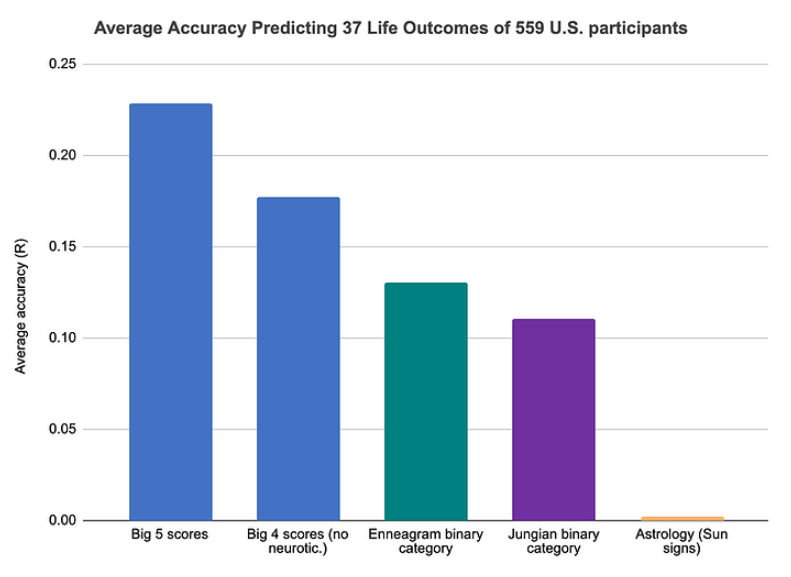
Just came across a nice, however small (N=559) and, AFAIK, non-peer reviewed, study comparing accuracy of popular personality test frameworks at predicting 37 different life outcomes (e.g., frequency of exercise, life satisfaction, number of close friends, etc.).
The main findings? They shouldn’t be a big surprise to I/O psych folks, but IMO they still contain two or three interesting, not widely known details.
- The Big Five personality test was more accurate than Jungian (MBTI-based) and Enneagram tests in predicting life outcomes. Fun fact, MBTI-style test was halfway between science and astrology, literally 🧙️
- The accuracy of these tools is negatively related to their popularity as measured by the frequency of Google searches.
- Removing Neuroticism from the Big Five reduced its predictive power significantly.
- Most personality traits form bell curves, suggesting that MBTI’s binary categorization may be less accurate.
- Continuous scores in the Jungian framework improved predictions over binary categories, but even with adjustments, the Big Five (minus Neuroticism) slightly outperformed the modified Jungian test.
- Jungian traits correlated with specific Big Five traits, but combining both tests didn’t enhance predictive accuracy.
- Despite its simplicity, the Enneagram performed better than the binary Jungian Type but was still less effective than the Big Five.
- Participants preferred their Jungian assessments, likely due to its more positive framing and missing Neuroticism trait.
Note: Link to the related Scientific American article.
Related notes
- The Big Five and different ways of succeeding
- Big Five vs. HEXACO
- Can a simple algorithm read your personality from your face?
- Do Insights Discovery ‘colors’ relate to self-reported skills?
- We are probably more similar - and different - than expected
📄 Read the original post with full outputs on my blog.