How are you planning to handle the statistical analysis for EUPTD pay gap reporting - especially for small worker categories?
The directive requires reporting by category of workers. Some of those groups will inevitably be thin (5–30 people). A standard OLS regression
on a group that small gives you a gender coefficient you can barely trust.
I’ve been thinking about partial pooling - hierarchical models that borrow strength across categories. Small groups get pulled toward the overall estimate; large groups keep their own. It’s a well-established technique, but I haven’t seen much discussion of it in the pay equity space.
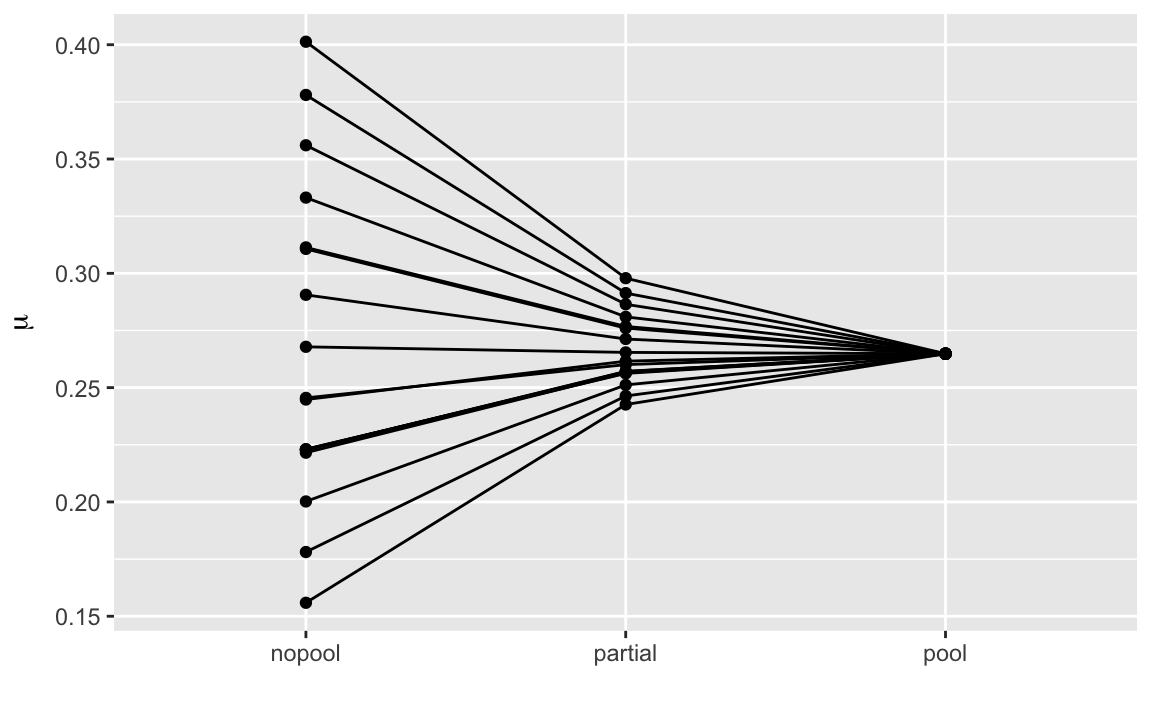
An illustration of how shrinkage works in hierarchical modeling across three pooling strategies. No-pooling treats each group independently, producing the highest variance in estimates. Partial pooling shrinks group-level estimates toward the global mean—balancing group-specific signal with overall trends. Complete pooling collapses all groups to a single estimate, eliminating between-group variance entirely. The vertical axis shows the estimated μ for each group; the horizontal axis compares the three approaches.
The interesting tension: shrinkage could pull a group’s gap below the 5% JPA trigger threshold. Is that a feature (better estimation) or a bug (masking real gaps)? 🤔
Also curious whether anyone is considering Bayesian approaches. Getting a direct probability that the gap exceeds 5% feels much more useful than a binary significant/not-significant answer from frequentist regression.
Would love to hear:
- What methodology you’re planning
- How you’re handling categories with few employees
- Whether you’re distinguishing between internal analysis and regulatory reporting methodology
June 2027 is closer than it looks 😉
Related notes
- Multilevel modeling in people analytics
- Using Bayesian shrinkage in reporting employee turnover
- Beyond prediction: Exploiting organizational events for causal inference in people analytics
- Evidence-based interventions that help reduce the gender pay gap
- Beyond the “flat Earth”
📄 Read the original post with full outputs on my blog.